| In recognition of National Youth Ultimate Giving Week, Tristan Green, Director of the Ultimate Foundation, sat down with participating USA Ultimate Affiliates from across the U.S. to gain insight into their organizations, youth programs, and investments in the future of ultimate. Find your local affiliate, and donate today! |
Altitude Ultimate’s Outreach Director and board member Libby Cravens and Senior Operations Manager Mike Richard share their experiences on the importance of investing in the future of the sport and supporting the dedicated organizers and programs that make local ultimate participation possible.
Tell us about Altitude Ultimate, your mission and how the organization has grown over time?
Libby: Altitude was established in 2014 by a lot of people that were really passionate. Each of them had their own personal motivations, so someone was really invested in middle school growth, someone in high school growth, one of them had a connection to a more elite community. At this point all but one of our original board members has moved on from the organization, but we’re still continuing their passion.
Another evolution of Altitude is we have been running some of the largest events in the country for a few years, and I would say that is something that we do well.
Mike: I think in general, the mission has remained the same. It’s just growth of ultimate, especially at the youth level. But nuances of that have changed over time. Post-COVID we’ve put a plan in place to grow at the middle school level, and we’ve been trying to recruit more girls to play ultimate.
When you look at how your organization has grown, are there any recent developments that stand out?
Libby: We’ve had grant funding for a couple of years now, and that makes a big difference, as well as having more consistent fundraising. It’s a lot of work and we don’t do it perfectly, but I feel really happy that our community shows up for us, and that we’ve been sustainable, because that’s a big deal as a non-profit.
Mike: Our growth as an organization, becoming larger in the population that we serve and in the scope that we’re able to offer, I’m proud of that. We’ve narrowed down board and employee roles, becoming more professional and focused has helped us serve our population better. I’m proud to see what the organization has done over time — not just my time with them, but over the 10-plus years we’ve been around.
What can ultimate as a sport create for young people both on and off the field?
Libby: I know Mike spent time as an educator, and I work in special education in schools as a speech pathologist. The social emotional development aspect of our sport, the leadership and communication skills and self-officiation, that’s all super unique. Time and again, I hear parents tell me that traditional sports were just not a good fit, but their daughter is now way more communicative and confident with her friends as a result of being a leader on the field. Working with coaches in the community and then creating leaders amongst our players, that aspect of the game — Spirit of the Game — we act like it’s special, because it is. And that social emotional development piece has also been huge for getting schools on board and getting grant funding. It ties into these things that post pandemic are super challenging and important for kids as they are learning to become young adults.
Mike: Ultimate is a good culture where there is something for everybody. So it has something for those that really want to push themselves and excel, get better, be super athletic and play at the highest level. But then it also provides opportunities and a place for people who just want to play recreationally, enjoy the community and maybe get a little exercise, but not push themselves in order to continue to progress in the sport. So I think that’s a huge part of the community and sport culture.
Off the field, ultimate helps build a lot of leadership skills. You can get opportunities to be a captain on your team. You get opportunities to bring new people in and, tying into the Spirit of the Game, there’s self-officiation as a big part of that as well.
What barriers prevent youth from participating in ultimate in your area and how is Altitude Ultimate working to address them?
Libby: I think geography is our biggest barrier, and field space as we grow is a challenge. Between our sliding scale model and offering full scholarships for anyone that needs them, I don’t feel that money is a main barrier, but there’s still growth there to be had. Just because we made something free, low cost or no cost doesn’t mean every kid that wants to can show up.
Our DISCover Ultimate Day had over 30 participants this year and two different rec centers brought a van’s worth of kids. And now we have their emails, but they’re in a location that’s not close to me or the other person we usually pay to do outreach. So even when we’re able to pay people, the location or the timing may not be right, or it doesn’t fit their life because they’re playing four days a week. I feel like we have to keep fighting for accessibility in specific geographic areas, creating that expansion.
Mike: Field space and access isn’t currently stopping youth ultimate from happening, but it’s close. It does feel like we’re at a max for what we can run. Especially in years where there’s a drought like this past year, we’re getting turned away from reservations. So is it a problem yet? Maybe not, but it might restrict our growth at some point in the very near future.
Is there anything specific you’ve learned that keeps kids involved in ultimate over the long term?
Libby: Relationships are at the core of what keeps people playing. Your college team is so special, if you played in college, and then as an adult club player if you are growing older and still playing, I think it’s because of the relationships with others that you meet. Even at the youth level, kids keep coming back because of the relationships they form. If they’re having fun with their friends, that’s what keeps people showing up.
Mike:, I totally agree, and I think another part of it is the flexibility of our sport. We have year round offerings for those that want it. Those kids that are diehards, they keep coming back and they’re like, “When’s the next thing?” They could play every day we have something going on. And then there’s others, they’re involved in the sport and they like it, but they also have their other sport, their other activity in our community. And our culture is welcoming. “You only want to play the spring season? That’s great. Come play the spring season and we’ll see you again next spring. That’s fine.” So I think those two together help keep as many as we can coming back to the sport.
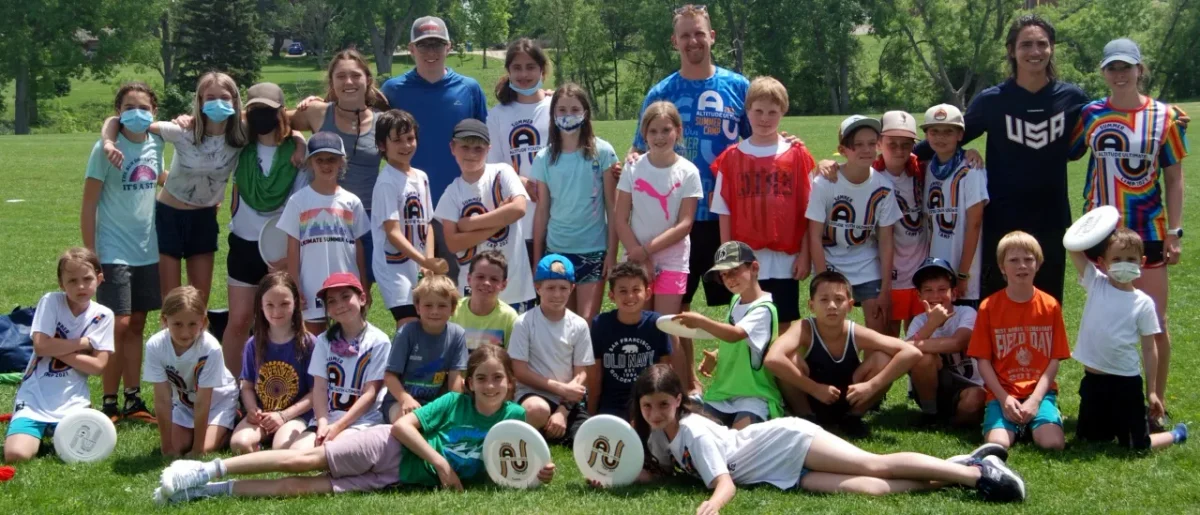
Can you just share how your USA Ultimate affiliate relationship supports the work of Altitude Ultimate?
Mike: I love it. It gives us access not only to resources, but the ability to do things like host YCC or run a giant national tournament like Masters. It helps youth to see play at different levels. The more events that we are bringing in and hosting, the more opportunities there are to see the sport, volunteer, watch, fall in love with it, and then continue their journey of becoming a lifelong ultimate player themselves.
For me that’s the biggest part, but it’s also monetary. Being an affiliate gives us access to run those things, which helps us raise money, which helps us support youth. It’s a big part of it, and it’s very important for us.
Libby: Also easily insuring our events, which protects player safety. And being able to send an email and then it’s not my problem. Knowing that the staff are there to help is a really valuable thing that’s available to us. They’re very accessible.
In what ways do you think local organizations contribute to the sport that might not always be visible at the national level?
Libby: Numbers don’t grow in a vacuum and I think that the organizers and coaches are so underappreciated. It’s all running on the backs of diehard volunteers who love this sport and are giving so much. If there weren’t people running youth programming, the sport wouldn’t continue to be what it is. Every college program that has someone come in with experience needs to thank their affiliates. They’re why that’s happening, because people are putting in the youth work.
Mike: Kind of piggybacking off that, the local groups really do drive the culture. You could grow up in Colorado playing high school ultimate and then move to anywhere else in the country. And all you have to do is find that affiliate or that local group and they’re going to plug you in and welcome you. I don’t know if that’s overlooked at the national level, but I think it does fly under the radar a bit.
Libby: Everywhere I’ve lived, there’s one super dedicated person that’s been organizing for 20 years, and they do it for that long without being paid. I’m not saying it’s a healthy model, because it’s not, but those people are so integral. The communities probably don’t realize, if you like playing leagues year round, you need to go thank this one person that essentially keeps it alive for you.
Mike: I agree with that a hundred percent. And I think it happens on an even smaller scale. I see it a lot within our community. Say a specific school’s team is massive because you have a dedicated coach and that program’s going to thrive. And then when their kid ages out and goes to high school and they leave the school, it’s often hard to fill those shoes. So I think you see that at all levels, down to even just one specific program or school.
Why is it important for the ultimate community to invest in the next generation of players?
Libby: When you have funding, you can take the pressure off of your org to run programs that are operating at a profit. Being able to operate a program at a loss is important because it’s how you try new things. It’s how you serve populations that aren’t going to be able to pay to be there. If you don’t fundraise, you don’t have that growth opportunity or that buffer.
Investing for the future is really important to be able to do that work. It allows you to try things and take risks that pay off even if money isn’t how you see the return. It allows you to pay coaches, pay for fields, which are not cheap. You can’t do the work without funding, and the community showing up and supporting orgs doing that work is awesome.
Mike: If we don’t keep investing, it’s not going to stick around. I have a daughter now, and if you want your kids to play, you want them to grow up with access to this great sport, you have to keep investing in it.
We’re getting to the point in the life cycle of the sport where it is multigenerational, it’s not just people who are in college that are playing. We have people who are 40 years out of college. And that’s where there’s kind of that opportunity for fundraising and philanthropy to be a big impactful driver.
Libby: Of course there are probably some players that are not invested in youth growth. But as someone who doesn’t have kids, this is still something that’s so important, when I think about the type of human that I became as a result of this – my teammates and my coaches and this sport. Giving kids the opportunity to fall in love with this sport is so motivating, to me personally, and I think to so many people. That feels like the thing that gets people out to support it, you want one more ultimate player out of Colorado, or Texas or whatever it is you’re from.